A species and its home
The dolphin & river
The Gangetic dolphin is part of an extraordinary river ecosystem. Get to know the animal, the pressures it faces and the Ganges basin it depends on.
Meet the species
The Gangetic dolphin
The Ganges river dolphin (P. gangetica) is one of two endangered species of South Asian river dolphin, the other being the Indus river dolphin, which is now found only in the Indus River in Pakistan. In Hindu mythology, the Ganges river dolphin is associated with Ganga, the deity of the Ganges River. The dolphin is said to be one of the creatures which heralded the goddess' descent from the heavens, and Ganga's mount, the Makara, is sometimes depicted as a dolphin. It has been recognised by the government of India as its National Aquatic Animal and is the official animal of the Indian city of Guwahati.
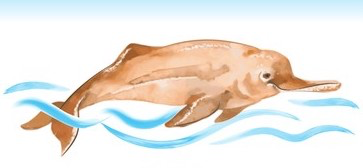
Both South Asian river dolphins have the long, pointed nose characteristic of all river dolphins, and their teeth are visible in both the upper and lower jaws even when the mouth is closed. They are unique among cetaceans in that they swim on their sides. The body is a brownish colour and stocky at the middle. These species have only a small, triangular lump in the place of a dorsal fin. The flippers and tail are thin and large in relation to the body size, which is about 2–2.2 meters in males and 2.4–2.6 m in females. The oldest recorded animal was a 28-year-old male, 199 cm in length. Mature females are larger than males.
Births may take place year round, but appear to be concentrated between December and January and March to May. Females gestate on average once every two years; gestation is thought to be approximately 9–10 months. After around one year, juveniles are weaned and they reach sexual maturity at about 10 years of age.
During the monsoon, South Asian river dolphins tend to migrate to tributaries of the main river systems. Occasionally, individuals swim along with their beaks emerging from the water, and they may “breach”: jumping partly or completely clear of the water and landing on their sides.
These species feed on a variety of shrimp and fish, including carp and catfish. The Ganges subspecies may take birds and turtles. They are usually encountered on their own or in loose aggregations; the dolphins do not form tight interacting groups. They rely on echolocation to find prey due to their poor eyesight: they lack a crystalline eye lens and have evolved a flat cornea. They are incapable of forming clear images and the dolphin is rendered effectively blind (these species are also referred to as the “blind dolphin”). The muddy waters, or low light conditions, that P. gangetica inhabits negate the use of the little vision that remains. However, the eye may still serve as a light receptor and it still uses its eye to locate itself.
The Ganges subspecies shows object-avoidance behaviour in both the consistently heavily murky waters of its habitat and in clear water in captivity, suggesting it is capable of using echolocation effectively to navigate and forage for prey. It most typically makes echolocation sounds such as clicks, bursts, and twitters.
Dolphins can be most commonly found in water with high abundance of prey and reduced flow. They migrate seasonally—downstream in colder conditions with lower water levels and upstream in warmer conditions with higher water levels. Being a mammal, the Ganges river dolphin cannot breathe in the water and must surface every 30–120 seconds. It favours deep pools, eddy counter-currents located downstream of the convergence of rivers and of sharp meanders, and upstream and downstream of midchannel islands.
A fragile habitat
Endangered species
Both subspecies of river dolphin are listed by the International Union for Conservation of Nature as endangered on their Red List of Threatened Species. They have been very adversely affected by human use of the river systems in the subcontinent.
Development and agriculture have had devastating impacts on their habitats as India undergoes an industrial revolution. The habitat of the Ganges river dolphin is within one of the most densely populated areas of the world and the natural resources in the dolphin habitat are under severe threat from over-exploitation by the communities who live close by as well as due to various developmental projects. Particularly the removal of river water for domestic and agricultural use.
In most of the areas, the riverbanks are used for agricultural purposes which poses a threat for dolphins. The Ganga is heavily polluted with 9000 tones of pesticides and 6 million tonnes of fertilizers used in the vicinity of the river each year. This is ecologically harmful to the Ganges river dolphin population both directly and indirectly. Pollutants entering into the dolphin habitats are also lethal to many organisms like zooplanktons, crustaceans, snails and fishes, which are a part of the food chain of dolphins and industrial and agricultural chemicals are biomagnified in the bodies of the dolphins, further contributing to population decline.
Perhaps the most significant issue is the building of more than 50 dams along many tributary rivers, causing the segregation of populations and a narrowed gene pool in which the dolphins can breed. An immediate danger for the Ganges subspecies in National Chambal Sanctuary is the decrease in river depth and appearance of sand bars dividing the river course into smaller segments as water level has lowered. Also increased use of water for various development projects has reduced the water quantity as well as quality.
Entanglement in fishing nets as bycatch can cause significant damage to local populations, and individuals are taken each year by hunters; their oil and meat are used as a liniment, as an aphrodisiac, and as bait for catfish. In some areas direct exploitation takes place side-by-side with degradation of habitats due to human pressures combined with development processes. The Ganges river dolphin is largely distributed where human population growth is also the highest, and environmental conservation is a lower priority as there are other pressing developmental needs.
The Ganges river dolphin is important not only because it is endangered, but also because it is a reliable indicator of the health of the Ganga and in fact the whole Ganga river ecosystem. It will face extinction in this century unless present trends are reversed.
The Indian government is not unaware of the problem and steps are being taken. On the occasion of the 74th Independence Day, 15 August 2020, the Indian Ministry of Environment, Forest and Climate Change announced 'Project Dolphin' to boost conservation of both river and oceanic dolphins. International trade is prohibited by the listing of the South Asian river dolphin on Appendix I of the Convention on International Trade in Endangered Species. It is protected under the Indian Wildlife Act, although these legislations require stricter enforcement. The Ministry of Environment and Forest declared the Gangetic dolphin the national aquatic animal of India and a stretch of the Ganges River between Sultanganj and Kahlgaon in Bihar has been declared a dolphin sanctuary, named Vikramshila Gangetic Dolphin Sanctuary, the first such protected area. The Uttar Pradesh government in India is propagating ancient Hindu texts in hopes of raising the community support to save the dolphins from disappearing. One of the lines being versed from Valimiki's Ramayan highlights the force by which the Ganges emerged from Lord Shivji's locks and along with this force came many species such as animals, fish, and the Shishumaar—the dolphin.
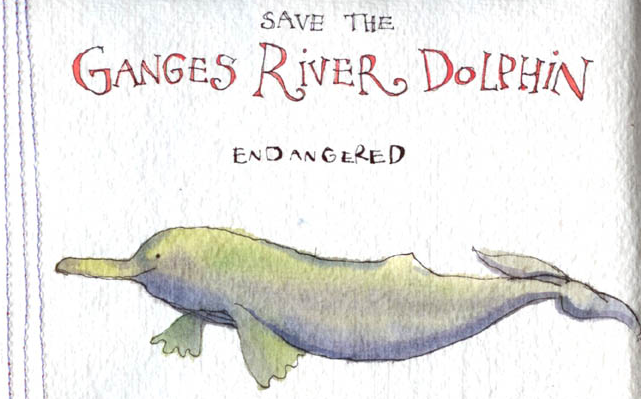
However, more needs to be done, hence this initiative “Save The Gangetic Dolphin”.
The wider ecosystem
The Ganges River
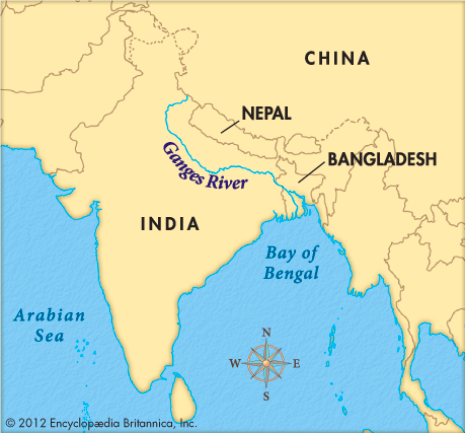
The Ganga originates at 4,000 meters above sea level in Gangotri, Uttarkashi District, Uttarakhand, India from the southern slopes of the Himalayan range. It flows through five states in India covering a distance of 2,510 km before it enters the Bay of Bengal.
The natural flow of the Ganga river has been obstructed over the years by the construction of barrages in the upstream, constructed either for power generation or for irrigation.
The Ganga basin is one of the most populous regions on Earth. It is home to 450 million people with an average density of over 550 individuals per square kilometre. In the delta zone this rises to over 900 per square kilometre. There are some 30 cities, 70 towns and thousands of villages along the banks of the Ganga. Nearly all of the sewage from these population centres—over 1.3 billion litres per day—passes directly into the river, along with thousands of animal carcasses, mainly of cattle.
A large number of factories/industries like sugar, chemicals, fertilizers, small-scale engineering, pulp, cotton and tanneries are situated on the banks of the river. The discharges from these industries enter the Ganga river directly or indirectly and pollute the river to a considerable extent. An estimated 260 million litres of industrial wastewater, largely untreated, is discharged by hundreds of factories per day.
The Ganga river also has religious and mythological significance. All along the Ganga, most of the ghats have religious importance. Pilgrims in large numbers, often in thousands, take a holy bath, cremate their dead and perform other post-cremation activities on the banks of the river and thus contribute to the pollution of the river.
Over the past three decades or so, the pollution of the Ganga has reached serious levels leading to local and national campaigns and actions to restore the health of the sacred river.
The Ganga supports a rich fauna and flora, including the Ganges river dolphin and at least nine other species of aquatic mammals. Reptiles include three species of crocodiles along with one species of monitor lizard and eleven species of freshwater turtles. The Ganga also has the richest freshwater fish fauna (378 species) anywhere in India. The riparian zone supports many plant species that are of both ecological and economic importance. Most plants play an important role in nutrient and water conservation and in controlling soil erosion. They also possess, in many cases, important medicinal properties.